

Publicerat 4 juni 2026
Celebrating Outstanding IB Achievement at SSHL: Curt Nicolin Academic Award 2026
This year, six SSHL students have been recognised with the Curt Nicolin Academic Award after achieving 40 points or more in the International Baccalaureate Diploma Programme.
The 2026 award recipients are Emil Stichler, Eleonore de Geer, Desiree Karlströmer, Elias Hultquist, Alma Silfverlin and Tilda Pesticcio.
Their results reflect not only strong academic performance, but also the consistency, resilience and commitment required to succeed across the two years of the Diploma Programme.
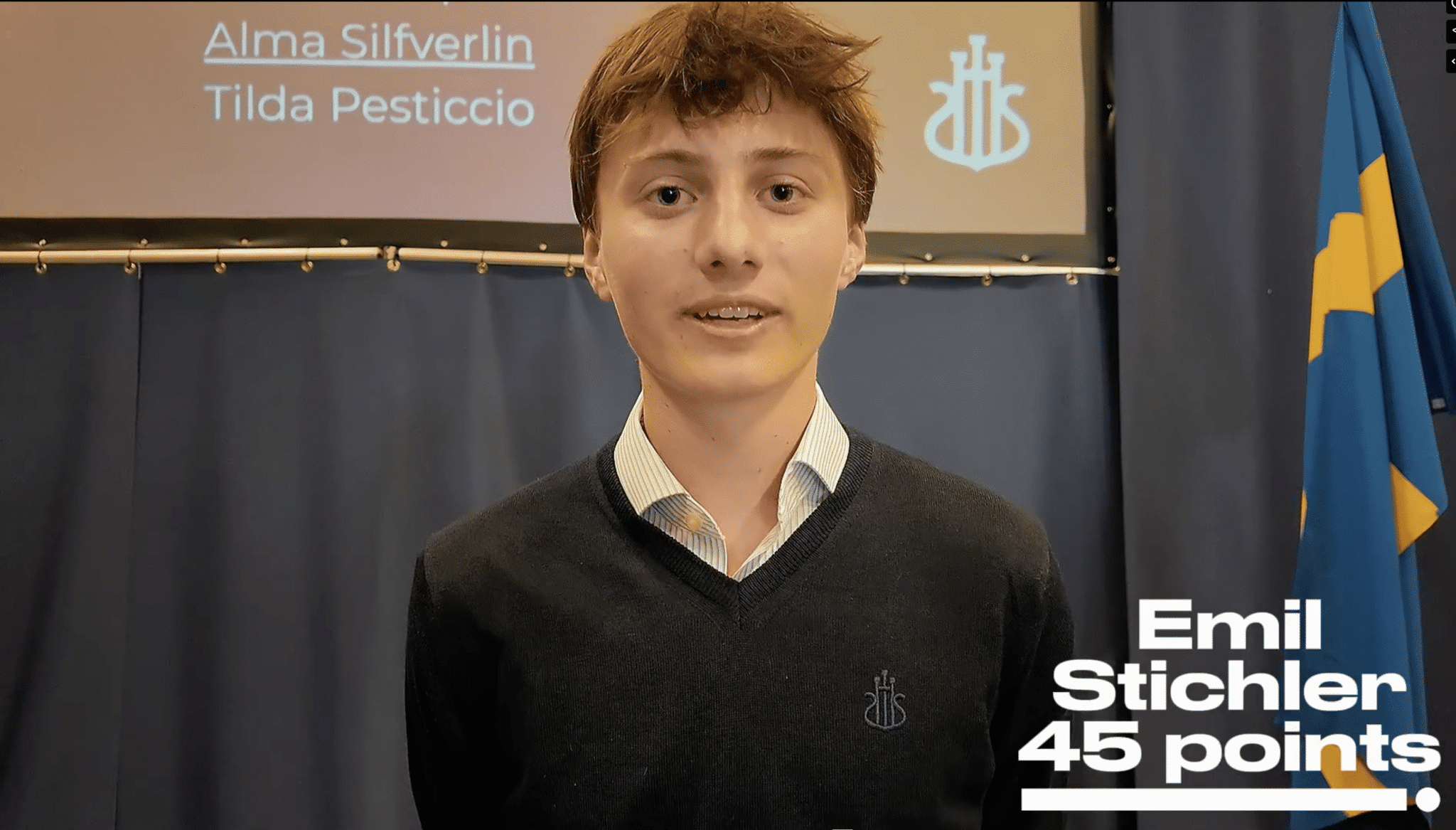
Watch the interview
Hear from this year’s award recipients about results day, the Diploma Programme and life at SSHL.
A perfect 45
Among this year’s recipients, Emil Stichler achieved the maximum possible IB Diploma score of 45 points, the highest result achieved by an SSHL student for several years.
When Emil began the Diploma Programme, however, a perfect score was far from an expectation.
“When I started the IB, I did not even know how many points there were,” he explains. His initial goal eventually became 40 points or more, but as he progressed through the programme he continued to raise his expectations.
“Did I expect to get 45 points at any point? No. Did I believe that it was possible? Always.”
For Emil, the result was particularly meaningful because his journey through the Diploma Programme had not always been straightforward. Early setbacks included receiving a 3 on one of his first English papers and challenging feedback on his first Extended Essay draft. Looking back, he believes those experiences made the final result even more rewarding.
Relief, pride and the end of a long journey
For several of this year’s award recipients, the first emotion on results day was not celebration, but relief.
Eleonore de Geer remembers 6 July as a day she had both anticipated and dreaded. Worried that she might miss her university offer, opening her results brought an immediate sense that “a massive weight had been lifted” from her shoulders.
Only later did the scale of the achievement begin to sink in.
“It took me some time to process what I had achieved,” she says, “so it is only now that I can truly enjoy the satisfaction of exceeding my personal expectations by that much.”
Desiree Karlströmer experienced something similar. Despite having confidence in her academic abilities, she describes the period between the final examinations and results day as stressful.
“When I finally opened them, I was incredibly relieved and proud of my achievements. It felt as though my hard work had finally paid off.”
Tilda Pesticcio also remembers the sense of relief that accompanied the results.
“Results day felt like a huge milestone in both our lives and secondary school education,” she says. “It was also relieving to know that the IB was over, and I was finally able to take a break from the academics to focus on my gap year plans.”
Emil likewise recalls relief as his immediate response. After two years in which he felt he had little certainty about exactly where his grades stood, seeing the final result meant that “the work had actually paid off” and made the two years feel worthwhile.
Consistency over two years
Asked what contributed most to their success, the students repeatedly return to one idea: consistency.
Eleonore describes discipline and time management as essential.
“As almost every IB teacher says, the IB is a marathon rather than a sprint,” she says. Completing tasks early helped her maintain a more balanced life, with hobbies and an active social life providing motivation to use her study time effectively.
Desiree agrees that the two-year nature of the programme makes sustained effort particularly important.
“While some may feel that two years is a lot of time, the programme covers a lot of material and moves quickly,” she explains. Being active in class and following a manageable study plan throughout the programme allowed her to approach the final examinations with greater confidence.
For Emil, an important part of that preparation came from learning to work within demanding expectations early in his time at SSHL. He highlights both the discipline encouraged by teachers such as Kimonas and the support and empathy he received from Christian, Gunilla and Rebecka.
“Ultimately, this combination is what made the IB manageable.”
Tilda similarly emphasises the importance of the people around her. She credits the support of her teachers and house tutor, Anny, with creating an environment in which she felt comfortable aiming high, asking for help and taking an active role in her learning.
Advice for future IB students
Although their experiences differed, this year’s award recipients offer remarkably complementary advice to students beginning the Diploma Programme.
For Desiree, being actively involved in lessons is key.
“Make sure to actively participate in class and use the resources which SSHL provides,” she says. She encourages students to ask questions, approach their teachers and make use of the support available to them.
Emil’s advice is similarly practical: do the homework consistently rather than waiting for deadlines, and ask teachers for additional help when necessary.
Eleonore emphasises something less measurable but equally important: curiosity.
“I think the best tool that you can have besides consistency is a genuine interest in what you are learning.”
She encourages students to choose Extended Essay, Internal Assessment and Individual Oral topics that genuinely interest them rather than simply selecting subjects that appear impressive on paper.
Tilda, meanwhile, stresses the importance of maintaining a life outside academics.
“My biggest piece of advice is to work on prioritising activities and commitments outside of school, in order to avoid burning out, as well as making the most of what SSHL has to offer.”
For boarding students in particular, she believes life at internatet forms an important part of the SSHL experience.
The challenges behind the results
High final scores do not mean that the Diploma Programme was easy.
Eleonore found one of the most difficult parts of the experience was learning to move on after an examination that had not gone as hoped.
“Nothing was as difficult as accepting that there was nothing I could do once the exam was over.”
Tilda identifies managing examination stress as one of her greatest challenges, particularly during mocks and the final examinations. Success often depended not simply on knowing the material, she says, but on remaining calm enough to organise thoughts and time effectively under pressure.
For Emil, the Internal Assessments and Extended Essay provided a different challenge: accepting that large pieces of work may never feel completely finished.
“The biggest challenge with them [was] to be confident in yourself and hand them in even though they don’t really feel finished yet. They are.”
New journeys after SSHL
The six award recipients are now moving on from SSHL and beginning very different next chapters.
Eleonore will move to England to begin Medicine at Imperial College London, where she will study for the next six years. Alongside university life, she hopes to travel and visit SSHL friends who are now living around the world.
Emil has chosen to defer his place at ETH Zurich for a year. He plans to spend his gap year with family while completing internships and smaller jobs and gaining experience of life outside school.
“A gap year teaches you things about yourself and what you want from life that a lecture hall never could,” he says.
Desiree is also taking a gap year, during which she plans to gain work experience, take online courses, develop her programming skills and found another company.
Tilda has returned to London and is currently working in a pub to save for her gap year. Next year, she plans to spend approximately three months travelling across Asia with her former Berga roommate.
More than academic results
Perhaps the most striking theme in the students’ reflections is that, when asked what they will remember about SSHL, they rarely mention grades.
Instead, they talk about friendships, teachers, boarding life and everyday moments.
Eleonore describes the combination of close boarding relationships and friendships formed in the classroom as a social environment that is difficult to recreate elsewhere.
Tilda similarly says that her time in Berga and the people she met through lessons and boarding are what she will cherish most.
“The people I interacted and spent time with are what I appreciate most from SSHL, as they are what ultimately changed my life.”
For Emil, some of the strongest memories are even simpler: running beside Mälaren in both winter and summer, playing table tennis during breaks, evening walks with friends and trips to the gym.
“Those routines are what actually built the fond memories I have of SSHL.”
The Curt Nicolin Academic Award recognises exceptional academic achievement, but the reflections of this year’s recipients also illustrate everything that surrounds those results: sustained effort, supportive relationships, setbacks, curiosity and the wider experience of being part of the SSHL community.
Congratulations to Emil Stichler, Eleonore de Geer, Desiree Karlströmer, Elias Hultquist, Alma Silfverlin and Tilda Pesticcio on their outstanding achievements.